Menu

  • Home
  • Members
    • Đăng nhập
  • Products
  • Fixy Tours
    • Hue: A city of “perfume and purple”
    • Saigon Unseen
    • Ten Iconic Dishes To Hunt For In Hue, Vietnam
    • Local Experiences Along the Tourist Trail in Hue
    • Saigon Street Food
    • Vietnam on a plate: a tour of Vietnam's best regional dishes
    • Move Over Pho! Bún Bò Huế Is The Vietnamese Soup You Need To Know About
    • India’s hidden subterranean stepwells captured in photos
    • Why do we have to raise airplane window blinds before landing?
  • Fixy News
    • Thực hư thành tựu xuất khẩu nông sản?
    • Người nghèo có bị ảnh hưởng khi giá điện, xăng tăng
    • Công thức làm đẹp bí mật từ đậu đen
    • Những nông dân xứ Mường Hòa Bình 'ăn nên làm ra' từ cây dổi
    • 10 nguyên tắc cần nhớ để phòng tránh ngộ độc thực phẩm
    • Fixyfood gound coffee
    • WHEN YOU EAT COULD BE JUST AS IMPORTANT AS WHAT YOU EAT FOR PREVENTION OF DISEASE
    • Six tips for sending your kid to school for the first time
    • 9 Ways to Support Your Child’s Creativity
    • Are There Health Downsides To Vegetarian Diets?
    • School lunches keep Japan's kids topping nutrition lists
    • Research reveals that you're still the same person after a drink
    • Irish agencies repeat don’t wash raw chicken message
    • A man had seizures after eating hot pot. Turns out he had tapeworms in his brain
    • Why we need fibre — and how we can get more of it
    • Head and neck injuries due to cellphone use are rising, according to study
    • Experts reveal the nine foods for perfect hair
    • The 30 Best Foods for Healthy Teeth and Gums
    • High-Protein Diet May Help Reduce Fatty Liver Risks - Experts Reveal
    • We must learn that brown fruit is not bad fruit
    • Is Rice & Beans Good for You?
    • The Many Health Benefits of Beans
  • Fixy Kids
    • Ai biết ăn dè
    • Chú ong lười biếng
    • Chú thỏ tinh khôn
    • Củ cải trắng
    • Đôi bạn tốt
    • Con cá thông minh
    • Bài học đầu tiên của gấu con
    • Gấu đen và hai chú thỏ
    • Sư tử và chuột nhắt
    • Cao và thấp
    • Chó sói và đàn cừu
    • Chú chồn lười học
    • Hai con ngựa
    • Hai con gà trống
    • Chú vịt xám
    • Chú chim vô duyên
    • Thỏ con thích nói dối
    • Con cú khôn ngoan
    • Con cừu đen
    • Một cách đếm thông minh
    • Gấu con chia quà
    • Chú gấu con ngoan
    • Người thợ săn và những chú chim bồ câu
    • Ngỗng và rùa
    • Con lừa khôn ngoan
    • Cây táo thần
    • Chuyện cô Mây
    • Công chúa ếch
    • Hanasaka Jiisan - Ông lão làm hoa nở
    • Bé ngoan của bà
    • Mùa thu của em
    • Đàn gà mới nở
    • Trăng ơi... từ đâu đến
    • Trâu ơi
    • Quê em
    • Nu na nu nống
    • Chăm vườn hoa
    • Cô dạy
    • Welcome
    • The Cradle
    • Chim sâu
    • Moon light on my yard
    • Ai dậy sớm
    • Little rose plant
    • The Snail Angel
  • Fixy Funs
    • Xem bói chuẩn xác nhờ mặc váy ngắn
    • Trải nghiệm thực tế khi lấy vợ
    • Tuyệt chiêu đòi nợ xấu
    • Giá cả không tăng nhưng vẫn buồn lòng
    • Tuyệt chiêu xác định con dâu của bà mẹ
    • Công chúa Lọ Lem và tấm bằng lái đánh rơi
    • Đứa con được yêu hơn
    • A cow herd heard
  • Fixy Foods
    • Black beans
    • Đậu đỏ, hương vị món ngọt truyền thống Nhật Bản
    • 14 lợi ích đáng kinh ngạc của hạt mè (vừng), bạn nên bổ sung ngay vào mùa đông
    • White Kidney Beans
    • Basil Seeds
    • Học Người Huế Làm Món Mắm Ruốc Thơm Ngon
    • Hạt dổi Fixyfood
    • Tiêu rừng - Mắc khén
    • Achiote Seeds
    • Lima Beans
    • Hulled Split Mung Beans
    • Fixyfood Mung Beans
    • 7 tác dụng của hoa hồi với sức khỏe
    • Amomum Tsao-ko
    • Kidney Beans
    • Indian Wampi leaf
    • Black sesame
    • Mè đen 200G
    • Mè trắng 100G
    • Xuyên tiêu
    • Gói hút Oxy
    • Fixyfood peanuts
    • Millets for Weight Loss – Foxtail Millet
    • Cách nấu bánh canh cá lóc Huế ngon mà đơn giản
    • The health benefits of soya
  • About Fixy
    • Công ty TNHH Fixy
    • Chính sách bảo vệ quyền riêng tư Fixy

Contact FIXY

For any information please do not hesitate to contact FIXY CO LTD using the followings:
  • info@fixyco.com
  • 84944897738
  • 168 Quang Trung, ward 10, dist Gò Vấp, HCMC
© FIXY CO LTD.
    Login Login Facebook Twitter FixyShop Map Contact

School lunches keep Japan's kids topping nutrition lists

Duy Anh
Posted 17-07-2020

(JapanToday) - Japan manages a rare feat for a developed country when it comes to feeding its children -- high scores for nutrition but very low obesity rates. One major key? School lunches.

A landmark report by the U.N.'s children agency UNICEF released Tuesday shows Japan topping the charts for childhood health indicators, with low rates of infant mortality and few underweight children.

But it also manages the lowest incidence of childhood obesity among the 41 developed countries in the Organization for Economic Cooperation and Development and European Union.

Experts say there are various factors at work, including a health-conscious society and regularly mandated check-ups for children, but a nationwide school lunch program also plays a key role.

"School lunches with menus that are created by nutritionists are provided to all primary schools and the majority of junior high schools throughout Japan," Mitsuhiko Hara, a pediatrician and professor at Tokyo Kasei Gakuin University, told AFP.

The lunches are almost mandatory -- no packed lunches allowed except for cases where special diets are required by their doctors for some kids -- and while they are not free for most, they are heavily subsidised.

Each meal is designed to have around 600-700 calories balanced between carbohydrates, meat or fish and vegetables.

One sample meal served to children in Japan's Gunma gives a flavor: rice with grilled fish and a spinach and sprout dish, served with miso soup with pork, alongside milk and dry prunes.

"School lunch is designed to provide nutrition that tends to be lacking in meals at home," education ministry official Mayumi Ueda told AFP. "I think it contributes to the nutritional balance necessary for children."

Unlike the cafeteria system operated in some Western countries, Japanese school lunches are usually served in the classroom. Pupils frequently dish out the food to each other and clean up the room afterwards.

There is no choice of meal, and no concessions offered for vegetarians, or anyone with religious restrictions, with members of either group being few and far between in largely homogenous Japan.

The lunches are conceived not only to feed children, but to teach them.

"There's also a daily broadcast at school to explain the nutritional elements contained in the school lunch of the day, and this is a good way to educate kids," Hara said.

At primary schools, students use magnets with pictures of food and place them into different categories on a whiteboard, learning to tell their proteins from their carbs.

"School lunch is positioned as part of education under the law," Ueda said. "It's not just about eating food, but children learn to serve, and clean up on their own."

The Japanese government studies nutrition and eating habits in Japan annually, and uses the results to shape what goes into the school meals, she added.

School lunches in Japan date back to as early as 1889, when rice balls and grilled fish were provided for children living in poverty in northern Yamagata prefecture.

But the program was expanded nationwide after World War II ended to address childhood hunger amid serious food shortages.

And there are other factors at work, Hara acknowledged.

"Because many Japanese are health-conscious, they try to eat a variety of food, which is good," he said.

"And we're taught to eat seasonal food, which also contributes to good health. Japan is one of the rare countries that pay so much attention to food that is associated with specific seasons," he added.

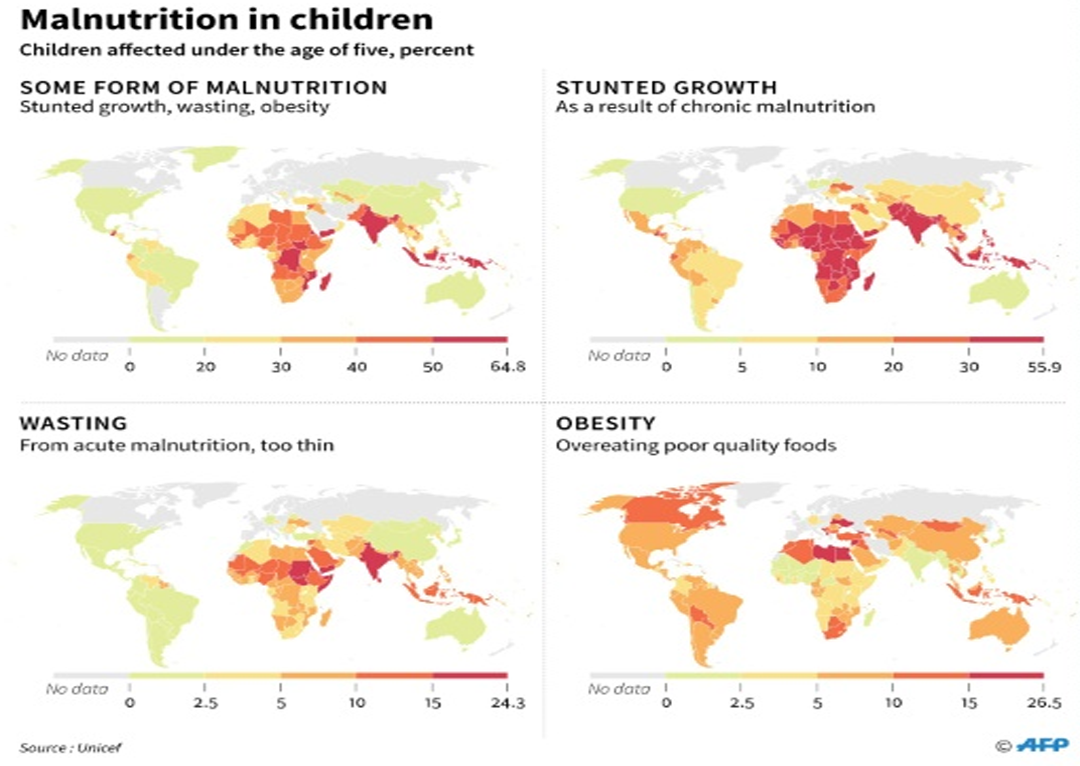
Sơ đồ dinh dưỡng trẻ em thế giới UNICEF 2019

The results are clear in the statistics: Japan has one of the world's lowest rates of infant mortality, and the rate of children aged five to 19 who are overweight or obese is 14.42 percent, far lower than most other developed countries.

The U.S. tops the UNICEF ranking, at 41.86 percent, with Italy at 36.87 percent and France at 30.09 percent.

Hara said another factor in Japan is regularly mandated childcare health checks. Parents of infants receive reminders from the local government, and children are given health checks at school, including measuring height and weight.

Still, even Japan has not escaped entirely the growing trend toward overweight children and childhood obesity, which in Japan, like elsewhere, tends to affect those from less wealthy families.

"Children in poverty are more likely to be overweight because families try to cut costs," Hara said. "As a result, they eat less protein but consume more carbs and sugar, which leads to obesity."

School lunches are all the more important to children in such situations, he said.

"A lot of nutrition is supplemented by school lunches... so it also serves as a meal that saves children in poverty."

By Natsuko Fukue

Dinh dưỡng Học đường Nhật Bản
Bình luận:
Please login to post or view comment
  • Similar articles
  • The Many Health Benefits of Beans
  • Is Rice & Beans Good for You?
  • We must learn that brown fruit is not bad fruit
  • High-Protein Diet May Help Reduce Fatty Liver Risks - Experts Reveal
  • The 30 Best Foods for Healthy Teeth and Gums
  • Experts reveal the nine foods for perfect hair
  • Head and neck injuries due to cellphone use are rising, according to study
  • Why we need fibre — and how we can get more of it
  • A man had seizures after eating hot pot. Turns out he had tapeworms in his brain
  • Are There Health Downsides To Vegetarian Diets?
  • Research reveals that you're still the same person after a drink
  • Irish agencies repeat don’t wash raw chicken message
  • 9 Ways to Support Your Child’s Creativity
  • Six tips for sending your kid to school for the first time
  • WHEN YOU EAT COULD BE JUST AS IMPORTANT AS WHAT YOU EAT FOR PREVENTION OF DISEASE
  • Fixyfood gound coffee
  • 10 nguyên tắc cần nhớ để phòng tránh ngộ độc thực phẩm
  • Những nông dân xứ Mường Hòa Bình 'ăn nên làm ra' từ cây dổi
  • Công thức làm đẹp bí mật từ đậu đen
  • Người nghèo có bị ảnh hưởng khi giá điện, xăng tăng
  • Thực hư thành tựu xuất khẩu nông sản?